
Waterfall enrichment · Updated
Treg review (2026): one gateway for thousands of APIs, unchecked data
Treg is a well-built gateway: one token for thousands of APIs, with waterfalls for email and phone ranked by cost. It forwards raw provider responses, and in our test 13% of its mobile numbers and 8% of its work emails were clearly wrong. Check what it returns before you send.
pipe0 sells data enrichment and competes with Treg in parts of this review. We say where Treg is better. How we review
Our score for Treg, the average of four criteria
One token and one bill for thousands of APIs at honest prices. Its cost-ranked waterfall finds a lot, but passes on invalid numbers and personal mailboxes that a check would have caught.
Best for
- Agents that need many data providers behind one token and one bill
- Teams that want to try providers without a contract with each
- Low-cost lookups where you verify every result anyway
Skip it if
- You send to what you get back without checking it
- You need to choose the order of providers by quality, not price
- A user is waiting on the answer: slow lookups can take minutes
One token and one simple call per lookup, but thousands of bundled endpoints that each return their provider's own JSON, which makes typed clients and large lists hard work.
Coverage close to a premium waterfall and numbers that matched Amplemarket's 72% of the time, but 13% of its mobile numbers were invalid or landlines and 8% of its work emails were personal mailboxes.
Prepaid, pay per result at each provider's own price with no markup, and most misses are free. Your own provider keys run unmetered.
An MCP server, a CLI and a cost cap per call. But endpoints have no docs of their own beyond a link to each provider's, and responses come back raw, untrimmed for an agent's context.
Treg at a glance
Treg in our benchmark
We ran the same records through every provider we test and counted who returned a result. These are Treg's numbers from October 2026.
| Test | Records | Treg | pipe0 waterfall |
|---|---|---|---|
| Find mobile number from LinkedIn URL | 97 | 84.5% | 93.8% |
| Find work email from LinkedIn URL | 120 | 79.2% | 83.3% |
How we tested
- Coverage counts usable answers only. We removed answers that were clearly wrong: mobile numbers that are invalid, missing a country code, or landlines (12 of Treg's 94, 4 of the waterfall's 95), and personal mailboxes returned as work emails (8 of Treg's 103, 1 of the waterfall's 101).
- Treg ran live with its default routing and a cost cap of $0.30 per mobile lookup and $0.05 per email lookup. The mobile test stopped at 97 people when our prepaid balance ran out.
- pipe0's waterfall figures replay its default providers' benchmark answers on the same people, in the default order.
- Each test ran on 97 to 120 records.
- The LinkedIn profile set passed one vendor's resolvability filter, so absolute rates run higher than on a typical list. Comparisons between providers stay fair.
- The pipe0 waterfall is pipe0's default provider order for each test. Its result combines those providers' results from the same run.
- Agreement is the share of results that match what other providers returned for the same person. It is a proxy for accuracy, not ground truth.
Run ids: 20261017T205207Z-a09a, 20261017T201255Z-b220. How we test
What is Treg?
Treg is a catalog of APIs for AI agents: 4,000+ endpoints from 113 providers, from SEO and social data to people and company enrichment, behind a single token. Superdesign, the team behind it, publishes the code on GitHub. You never sign up with the providers. Treg calls them with its own keys, or with keys you add, and bills a prepaid balance per call.
Most of Treg is a relay: a call to a provider endpoint returns that
provider's response unchanged. For a few common jobs, mostly finding an
email or a phone number, Treg has routed endpoints. Ask
treg.people.email.find or treg.people.phone.find for a person, and Treg
tries the providers that can answer one at a time until one returns
something. It ranks them on every call by expected cost per hit, your own
keys first, using hit rates it measures across all its users. The response
names the provider that answered, every provider tried before it, and what
each one cost.
How it did in our test
We ran Treg's routed lookups live on LinkedIn profiles from our provider benchmark and compared them with pipe0's default waterfalls on the same people.
On coverage, Treg holds its own. It returned a mobile number for 94 of 97 people and a work email for 103 of 120, about as many as our waterfalls. Its first provider, Blitz, is fast and accurate: it answered half the email lookups in under a second, and those answers matched other providers 96% of the time.
The problem is what comes back when the first providers miss. Treg's waterfall takes the first answer from whichever provider is next in price order, and some of them return data that is plainly wrong.
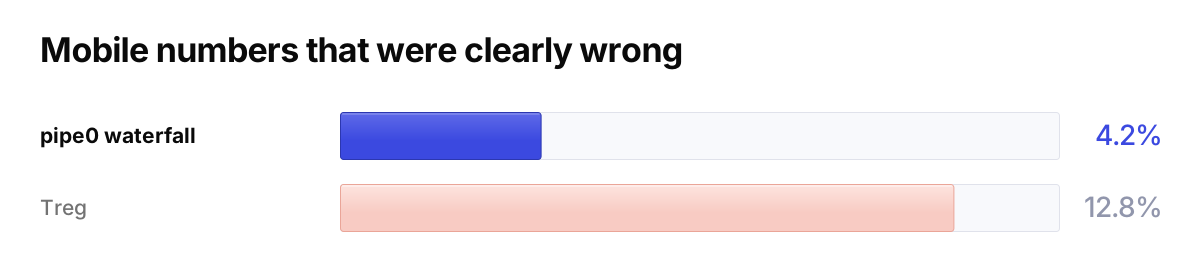
Of Treg's 94 mobile numbers, 12 could not be dialled as mobiles: six were invalid or too short, three could not be parsed, two were landlines and one was a business line. Six of the twelve came from Aviato, which often returns US numbers without the +1, and Treg passes them on unchanged.
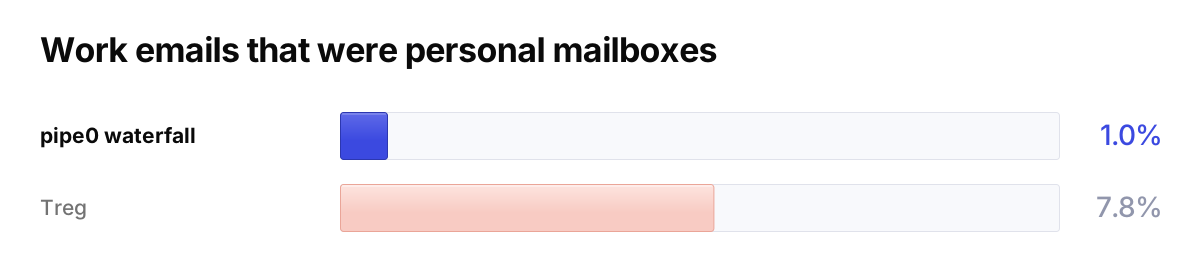
On email, 8 of 103 answers were personal mailboxes such as Gmail, Yahoo and Hotmail. LeadMagic's personal email finder sits inside Treg's work email route, and Tomba returned the rest.
After removing those, Treg's usable coverage was 85% on mobile numbers and 79% on work emails, against 94% and 83% for pipe0's default waterfalls.
| Mobile numbers, 97 people | Treg | pipe0 waterfall |
|---|---|---|
| Usable numbers | 82 (85%) | 91 (94%) |
| Clearly wrong, removed | 12 | 4 |
| Matched other providers' majority answer | 77% | 85% |
| Average time per lookup | 7.1 s | 6.8 s |
| Cost per usable number | $0.11 | $0.14 to $0.18 |
Do they return the same data?
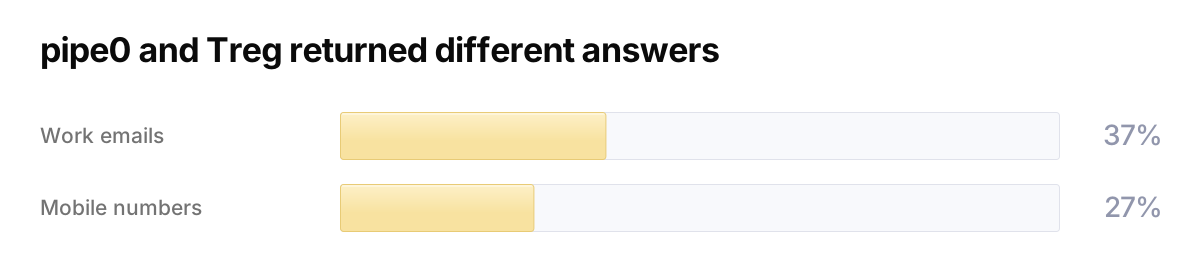
Often not. For the 94 people where both Treg and pipe0's waterfall returned a work email, they returned different addresses for 35 of them. For mobile numbers, 25 of 94 were different. When two waterfalls disagree on the same person, at most one of them is right.
How often a provider agrees with premium sources is the best signal of accuracy we have. Treg's mobile numbers matched Amplemarket's 72% of the time, a typical rate: Wiza, Prospeo and LeadMagic land at 72 to 73%. With Surfe it was 69%, lower than most providers we test, which match Surfe 77% of the time or more. And Treg agrees with low-cost providers about as often as with premium ones: nothing in its routing pulls its answers toward the sources we trust most.
Treg returned the same mobile number as other providers 69 to 76% of the time
Treg's mobile accuracy is about average, slightly below on premium sources: it agrees with Amplemarket and Surfe no more often than with low-cost providers, and less often with Surfe than most providers we test.
Speed
Speed depends on how far down the list a lookup goes. When the first provider answers, Treg returns in about a second. Each miss adds the next provider's time, and some of them are asynchronous, so a lookup that falls through five or more providers averaged 47 seconds in our email test, and 7 of 120 ran past our 2-minute timeout. Mobile lookups were faster, at 7.1 seconds on average.
What it costs
There is no subscription. New accounts get $1 of credit, and after that you top up a prepaid balance from $10. Each answer costs exactly what the provider that found it charges, from $0.0005 for Blitz to $0.75 for Lusha on phones, and Treg adds no markup. Misses are free on all phone providers and all but one email provider, and a cost cap per call stops a lookup from reaching the expensive end of the list.
For mobile numbers, that came to $0.11 per usable number in our test, below what pipe0 charges for its default waterfall. If you already pay for a provider, you can add your key and those calls run unmetered.
Treg for agents
The gateway itself is well built. An agent sets itself up from one line,
set up treg - https://treg.to/llms.txt, and gets an MCP server, a CLI and
a guide written for it. Every call can carry a cost cap and an idempotency
key, prices are shown before you spend, and an out-of-balance call is
refused with a clear message instead of failing halfway.
What sits behind it is less agent-friendly. Treg forwards each provider's response as it is: nothing is filtered, shortened or made uniform for an agent's context window, so the agent reads every vendor's full payload in every vendor's format. The real gain over separate MCP servers, or over teaching an agent each provider's API, is the single gateway: one token, one bill and one way to call.
Documentation is thin for the same reason. Each endpoint has a catalog entry with its input fields, an example call and a link to the provider's own docs, but no Treg page that explains how to use it, and no description of what comes back, because what comes back is the provider's raw response.
The bundling has a cost too. Thousands of endpoints sit behind one token, and apart from the few routed lookups, each returns its provider's own JSON in its own shape. An agent has to choose among all of them, and a team that wants a strongly typed API client has to model every response it uses itself. For a large list, the agent also stores, joins and re-runs every result on its own.
How Treg differs from pipe0
Treg and pipe0 overlap on waterfalls, but they are built for different jobs. Treg is plumbing around a call: one token, billing, key management, a cache of past answers shared across its users, and the provider's raw response. Nothing in it stores the people or companies you look up, so your agent keeps the results, joins them to your list and decides when to look again.
pipe0 is a stateless enrichment API too, but it wraps retrieval in a data model. Every lookup returns typed fields in the same shape whichever provider answered, and an agent can chain lookups, checks and transformations into multi-step automations in a single request. Default waterfalls are ordered for answer quality rather than price. Sheets are an optional cloud environment on top, for lists that need to persist or run on a schedule. Treg's catalog is far broader, with long-tail APIs from TikTok data to text to speech. pipe0's is narrower and goes deeper on sales data.
Who should use Treg
Use Treg if you are building an agent that needs many data sources behind one token, and you check what comes back. Its catalog, pricing and tooling are hard to beat for that.
Look elsewhere if the data goes straight into outreach. A waterfall ranked by cost needs a check after it, for valid numbers and real work addresses. pipe0 runs its waterfalls in a quality-first order, and lets an agent chain the checks that catch these errors into the same request.
Treg pros and cons
Pros
One token for 113 providers
Treg's catalog lists 4,000+ endpoints from 113 providers. You never sign up with them: Treg injects its own keys, or yours, server-side.
Honest, visible pricing
Each answer costs what the provider that found it charges, with no markup, and the price is shown before the call. A miss is free on all 15 phone providers and 24 of 25 email providers.
Coverage close to a premium waterfall
It returned a mobile number for 94 of 97 people and a work email for 103 of 120, about as many as pipe0's default waterfalls.
Transparent answers
Every response names the provider that answered, every provider tried before it, and what each one cost.
Cons
Clearly wrong data passes through
12 of its 94 mobile numbers were invalid, missing a country code, or landlines. 8 of its 103 work emails were Gmail, Yahoo, Hotmail or Outlook addresses.
Order by price, not quality
Providers are ranked by expected cost per hit and the first answer is final. The wrong data came from providers lower in the order, which answer when better ones miss.
A long tail of slow lookups
Half its email lookups ended in under a second, but 10% took more than 80 seconds, and 7 of 120 ran past our 2-minute timeout. Those were still charged.
Heavy bundling, untyped responses
Thousands of endpoints behind one token, each returning its provider's own JSON, and nothing stored. Typed clients, joins and re-runs on large lists are yours to build.
Treg pricing
Treg has a free plan. Paid plans start at $10 minimum prepaid top-up, after $1 of free credit.
| Plan | Price | What you get |
|---|---|---|
| Free credit | $0 | $1.00 of credit, once, for a new verified account. |
| Prepaid balance | $10 to $2,000 | Top up and pay per call at each provider's price, no markup. $5 bonus at $50, $10 at $100, $15 at $200. |
| Your own keys | Unmetered | Calls through provider keys you already pay for are not charged to the balance. |
- Routed lookups bill the provider that answered, plus any provider tried before it that bills a miss: 1 of 25 for email, none for phone.
- A cost cap per call (default $1) bounds how far down the list a lookup may go.
Prices as of Oct 17, 2026, from Treg's pricing page.
Treg alternatives
| Alternative | Pick it when |
|---|---|
| pipe0 | You want waterfalls ordered for quality and typed results your agent can chain into checks and multi-step automations. |
| Surfe | You want the highest mobile coverage we measured from one API, with its own waterfall of 15+ providers. |
| FullEnrich | You want a waterfall that verifies emails and phones before it returns them. |
Side by side, feature by feature: pipe0 vs Treg.
Frequently asked questions
What is Treg?
Treg is a catalog of 4,000+ data and tool endpoints from 113 providers behind one token, built for AI agents. Its routed lookups, such as finding an email or a phone number, try providers one at a time, ranked by expected cost per hit, and return the first answer.
Is Treg's data accurate?
It finds a lot, but not all of it is usable. In our test, 12 of its 94 mobile numbers were invalid, missing a country code, or landlines, and 8 of its 103 work emails were personal mailboxes. Its numbers agreed with other providers 66% of the time.
How much does Treg cost?
New accounts get $1 of credit. After that you top up a prepaid balance from $10 and pay each provider's own price per result, with no markup. Most misses are free, and calls through your own provider keys are not charged.
Does Treg have an MCP server?
Yes. Treg has an MCP server, a CLI, and an llms.txt guide an agent can set itself up from.
Treg or pipe0: what is the difference?
Treg is a gateway: one token for thousands of APIs, returning each provider's raw response, with waterfalls for a few lookups ordered by expected cost per hit. pipe0 is also a stateless enrichment API, but it wraps retrieval in a data model: typed fields an agent can chain into checks and multi-step automations, with waterfalls ordered for quality. In our test pipe0's returned usable mobile numbers for 94% of people against 85% for Treg.
Next-gen enrichment & search.
Build revenue systems that scale. For humans, agents, and apps. Replace tools like Clay, n8n, Hightouch, etc.

 Try pipe0