· Sales data · 3 min read · Updated
The Best Clay Alternatives for Data Enrichment (2026)
Seven Clay alternatives compared on data quality, price, and how well they work with AI agents, plus when Clay is still the right pick.

›In this post · 6 sections
Clay made spreadsheet enrichment mainstream. Teams now leave it for three reasons: the bill grows faster than the list, tables cap at 50,000 rows, and the agents they already use, like Claude Code or Codex, can't build in it.
The last reason is the one that will matter most. An agent needs a medium it can read and change on its own. Clay was built for people clicking, and data-only APIs hand the agent data but leave the building to you. Keep that in mind as you read the list.
Quick comparison
| Tool | Best for | Data quality | Price |
|---|---|---|---|
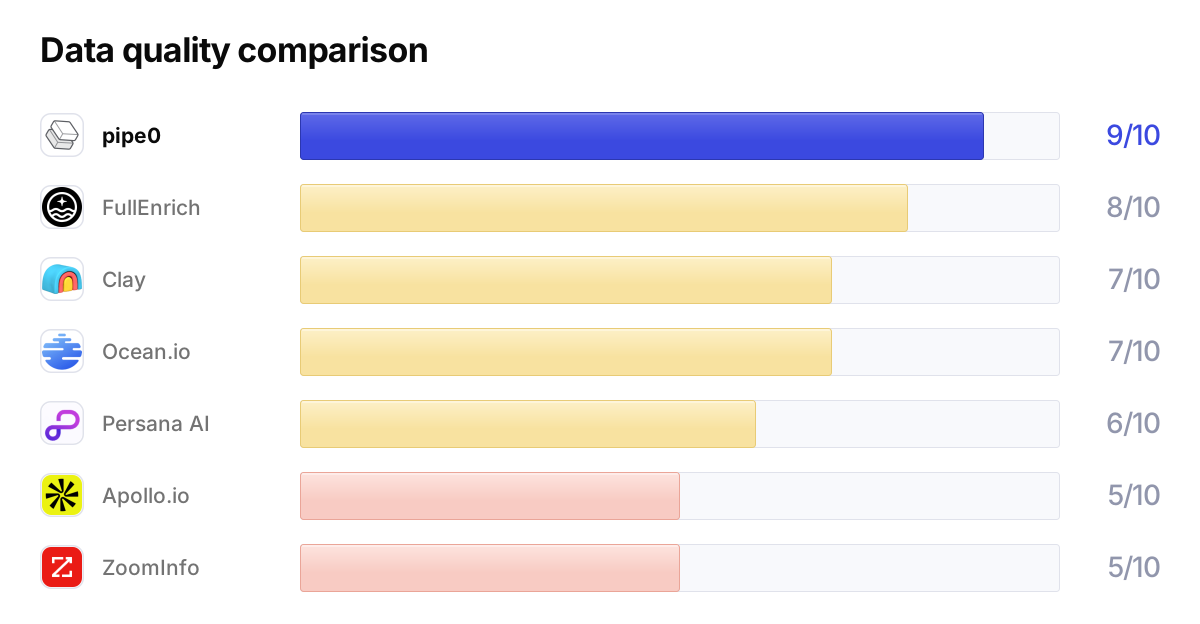
| pipe0 | Clay-style sheets your own agents can build and run | 9/10 | From $49/mo, 6–12x cheaper than Clay |
| Apollo.io | Prospecting and outreach in one tool | 5/10 | From $49 per seat/mo |
| ZoomInfo | Enterprise teams that want the biggest US database | 5/10 | Annual contract |
| FullEnrich | Finding emails and phone numbers, nothing else | 8/10 | From €55/mo |
| Ocean.io | Finding lookalike companies | 7/10 | From $250/mo |
| Persana AI | Agent-driven prospecting | 6/10 | From $85/mo |
| n8n | Building your own automation, data not included | n/a | From €20/mo |
| Clay | Teams whose playbooks already live in Clay | 7/10 | From $185/mo |
pipe0
pipe0 does what Clay does, sheets that enrich people and companies across 50+ providers, and makes all of it something an agent can operate. Ask Claude Code or ChatGPT a data question and get an answer back. Describe a play, and the agent builds a sheet you can see, change, and schedule. Sheets hold 2 million rows, every change can be undone, and the same engine is a REST API and an MCP server. On average it runs 6–12x cheaper than Clay. The pipe0 vs Clay page has the side-by-side.
Apollo.io
Apollo bundles a contact database, sequencing, and a dialer into one per-seat product. If you want one tool to find and email prospects, it covers more of the funnel than Clay. Its data comes from one source, Apollo's own database, so coverage thins outside the US and outside common titles.
ZoomInfo
ZoomInfo is the enterprise incumbent: deep US coverage, org charts, intent data, and the compliance answers procurement asks for. It's a database, not a flexible enrichment table, so teams pair it with other tools rather than replace Clay with it. Reconsidering ZoomInfo itself? See ZoomInfo alternatives.
Four more, quickly
- FullEnrich finds emails and phone numbers across many vendors, and does nothing else. A focused swap if contact details are all you use Clay for.
- Ocean.io finds lookalikes of companies you've won. It complements a Clay-style tool more than it replaces one.
- Persana AI lets its own agents build and enrich lists. It's joining forces with Rox, so check where it's heading.
- n8n is automation without data. Pair it with an enrichment API like pipe0 and skip the provider plumbing.
When Clay is still the right pick
Clay has the largest template library and community in the category, more integrations than anyone, and an ecosystem of agencies that know it well. If your team runs on prebuilt playbooks and clicks through them by hand, stay. If you want your own agents to build and run the work, need more than 50,000 rows, or want a smaller bill, try pipe0.
Frequently asked questions
What is the best Clay alternative?
For most teams, pipe0. It does what Clay does, sheets that enrich people and companies across 50+ providers, and lets the AI agents you already use build and run them. If you only need emails and phone numbers, FullEnrich is a focused option. If you want prospecting and outreach in one tool, look at Apollo.
Is there a cheaper alternative to Clay?
Yes. pipe0 is on average 6 to 12 times more cost-efficient than Clay, with plans from $49 a month. Clay starts at $185 a month.
Which Clay alternative has the best data quality?
pipe0 rates highest at 9 out of 10, followed by FullEnrich at 8. Clay and Ocean.io rate 7, Persana AI 6, and Apollo and ZoomInfo 5.
Does Clay have an API?
Clay's API is a remote control for the Clay workspace. It triggers tables, functions, and workflows that live in Clay, but it isn't a data API you can build a product or a data sync on. pipe0 offers a stateless data API and an MCP server on the same engine as its sheets.
Can AI agents like Claude Code use a Clay alternative?
Yes. pipe0 connects to Claude Code, ChatGPT, Cursor, and other MCP clients, and the agent can answer data questions directly or build a sheet, enrich it, and schedule it. Clay's agents can't build tables through Clay's official tools.

 Try pipe0